Previously, we looked at what school leaders can do to support multilingual learners during the Pre-production (Silent/Receptive) stage, those first weeks or months when students are taking in language long before they’re ready to produce it. We argued that silence is a form of learning, not disengagement. Supporting students at that stage means building classrooms where they eventually feel safe enough to try.
If you missed it, start with Before They Speak: A Leader’s Guide to Supporting Newcomers in the Silent Period.
Now comes the moment everyone has been waiting for: a student who has spent weeks quietly observing finally answers a question.
“Yes.”
Later that day, they whisper two words to a partner, and the next morning, they offer a memorized phrase during morning meeting. These milestones are worth celebrating, which is why they deserve a plan.
Within a few days, the same student who felt safe offering a one-word answer is called on in front of the whole class. Another teacher encourages them to “say the whole sentence.” A third assumes that because they’re talking now, they’re ready for more complex questions.
All of those responses come from good intentions, and celebrating progress is exactly the right instinct. But without a shared understanding of what Early Production looks like, those good instincts can unintentionally ask students to take bigger risks before they’re ready.
The confidence that led to those first words rarely disappears because someone made a mistake. It fades because every classroom responds differently. Protecting it is a systems problem, and the work of school leadership is making sure a student’s willingness to take a risk doesn’t depend on which classroom they walk into next.
Contents
What Is the Early Production Stage?
The Early Production stage is when multilingual learners begin experimenting with English. Students often communicate through single words, memorized phrases, yes/no responses, or familiar language they’ve heard repeatedly. Their understanding continues to grow much faster than their ability to express themselves, and using their home language alongside English remains an important support, a foundation we explore further in Bilingual Education in the 21st Century.
Errors are expected. In fact, they’re evidence that learning is happening. Progress at this stage also isn’t linear. A student may offer a full sentence one day and retreat to single words the next, and that variation often has more to do with context, comfort, or the demands of a specific task than with a step backward in language development.
At this stage, the goal is output over polished language.
Students need sentence frames, predictable questions, opportunities to collaborate with peers, and repeated exposure to vocabulary they can confidently use. They benefit from hearing accurate language modeled naturally rather than having every mistake corrected in the moment.
Our pillar guide introduces all six stages of second language acquisition and the instructional practices that support students at each one. In this series, we’re slowing down to examine each stage individually. Here, we’re focused on supporting Early Production ELLs from the perspective of the leaders responsible for building a steady experience across an entire school.
What Early Production Asks of a School’s System
Early Production feels encouraging because students are finally speaking. But speaking is only the beginning. What each classroom does next is what determines whether that risk-taking continues.
If one classroom protects a student’s first attempts at language while another unintentionally raises the stakes too quickly, the learner receives conflicting messages about when it’s safe to participate.
The challenge is making sure every adult understands Early Production and responds to it the same way. That means building systems that make thoughtful instructional choices the default rather than the exception.
Across a school, that looks like:
- Predictable low-stakes speaking routines across every classroom. Partner conversations and small-group discussions should already be part of instruction before a student reaches Early Production.
- A shared understanding of what success looks like. Staff should recognize that one-word answers, memorized phrases, and frequent errors are signs of healthy language development.
- The same instructional supports in every classroom. Sentence frames, repeated vocabulary, visual supports, and familiar question formats shouldn’t vary from teacher to teacher. Students should encounter the same scaffolds throughout their day.
- Coordination across the student’s schedule. A newcomer may interact with six or seven educators before lunch. Leaders create the conditions for those educators to reinforce one another rather than unintentionally pulling students in different directions.
When schools establish these expectations collectively, students don’t have to relearn whether it’s safe to speak every time the bell rings.
What Leaders Should Put in Place
Leading the Early Production stage well comes down to four systems, each one closing a different gap where good instincts can outpace where students actually are.
1. A Consistent Low-Stakes Speaking Rollout
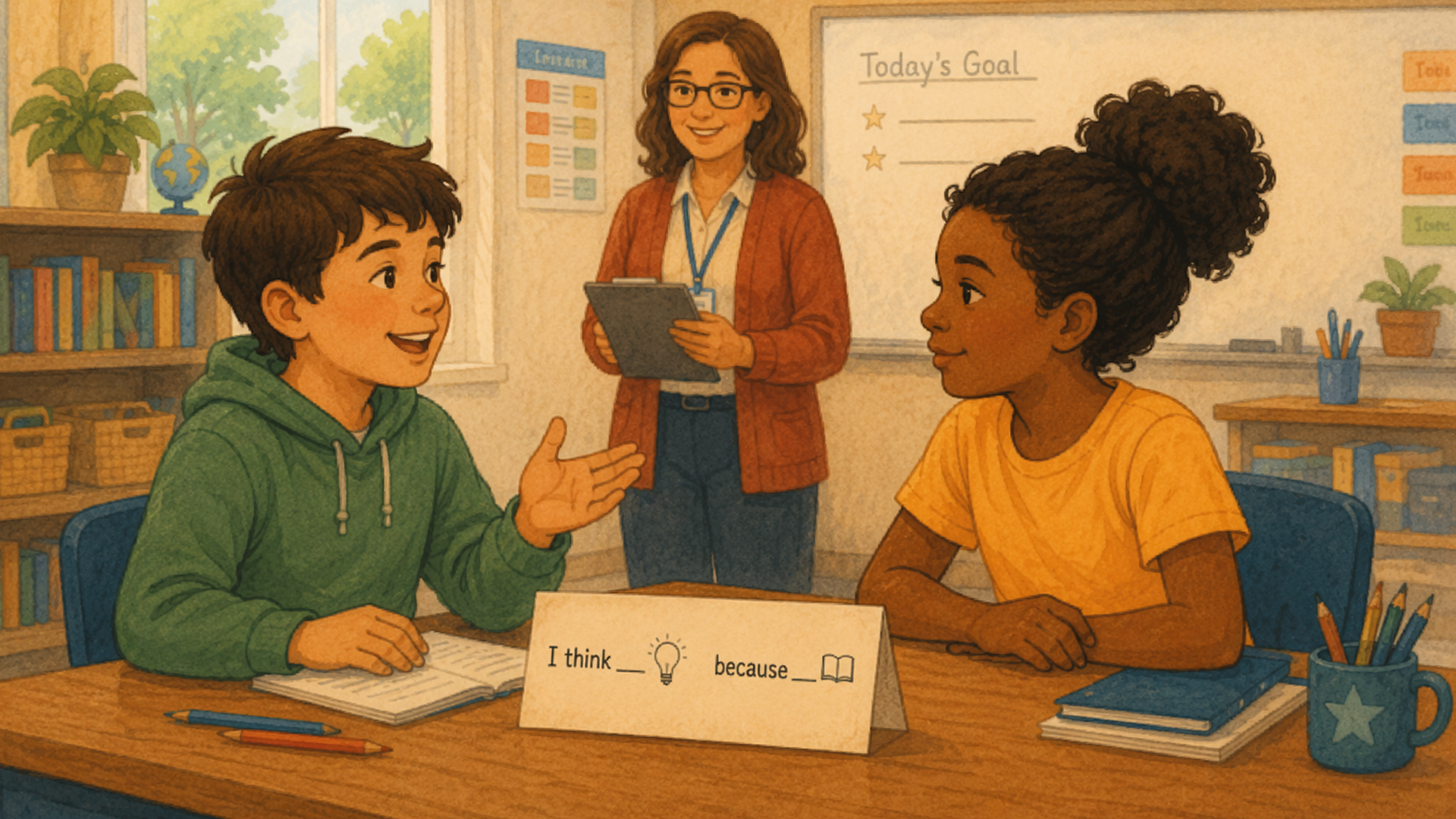
The safest place for a student’s first spoken words is rarely in front of 25 classmates. They’re more likely to emerge during a conversation with a trusted partner or while rehearsing a sentence in a small group before being shared publicly.
Those opportunities should be part of the school’s shared instructional practice.
Leaders can make this happen by creating shared routines that every classroom adopts. Faculty meetings become opportunities to exchange successful sentence frames and predictable question stems. Grade-level teams can build common banks of vocabulary supports that grow throughout the year. Coaches can facilitate conversations about partner structures that encourage participation before whole-class discussion ever begins.
The goal is reducing unnecessary variability. When students experience familiar speaking structures throughout the building, they’re free to focus on language instead of wondering what today’s expectations will be.
Roundtable conversations among staff are especially valuable here. Teachers often discover that strategies working in kindergarten transfer surprisingly well to middle school newcomers, or that a simple adjustment to partner talk dramatically increases participation across grade levels. Giving educators regular opportunities to share those observations turns isolated successes into school-wide practice.
By the time a newcomer reaches Early Production, low-stakes speaking shouldn’t feel like a special accommodation. It should simply feel like how your school helps students learn.
2. Shared Expectations So Every Classroom Protects the Same Risk-Taking Space
One teacher hears a student say, “Yesterday I go park.” They smile and say, “I went to the park? Tell me more.”
Another teacher hears the same sentence and immediately asks the student to repeat it correctly.
Both want the student to succeed, but those interactions communicate very different messages about what matters most.
At the Early Production stage, protecting a student’s willingness to communicate is often more important than perfecting grammar. Accuracy still matters, but it develops best when students keep taking risks.
Leaders have an important role in helping staff distinguish between modeling language and interrupting communication. A shared expectation for light-touch correction helps every teacher strike that balance. Rather than stopping students mid-thought, educators can naturally model accurate language while keeping the conversation moving. Students hear the correct form without feeling that every attempt is being evaluated.
Staff also need to recognize that a student who’s finally talking hasn’t caught up. Their needs have shifted and are different now than they were a few weeks ago.
Without that common frame, it’s easy for expectations to get ahead of language development, not because anyone intended to rush students, but because progress naturally invites us to ask for just a little more.
A leadership team’s job is to help every classroom recognize where that line is and to protect it together.
3. Instructional Coaching That Supports the Instinct to Celebrate Progress
One of the most valuable coaching conversations during the Early Production stage looks past whether students are speaking and into how the classroom is making that speaking possible.
By this point, many teachers are eager to see multilingual learners participate more. That’s a positive instinct. Coaching can help ensure that enthusiasm translates into practices that build confidence and raise the stakes with intention, one careful step at a time.
During classroom walkthroughs, leaders and instructional coaches can look for small but meaningful indicators:
- Are students rehearsing ideas with a partner before sharing with the whole class?
- Are sentence frames and visual supports still in active use, even as students begin speaking more?
- Are teachers expanding on students’ responses by modeling language rather than interrupting the flow of communication?
- Are students experiencing success through low-stakes interactions before they’re expected to speak in front of the entire class?
What happens after the walkthrough is equally important. Rather than focusing only on what could improve, coaching conversations should name the practices that are already helping students take risks.
“I noticed your newcomer rehearsed with a partner before sharing.” “The sentence frame gave them a place to start.” “You modeled the correct language without stopping the conversation.”
Those observations reinforce that the goal is creating the conditions that make speaking feel safe enough to happen again tomorrow.
Over time, those coaching conversations establish a shared understanding of what effective Early Production support looks like. Teachers begin hearing the same language from coaches, administrators, and colleagues, making that alignment part of the school’s culture rather than the responsibility of individual educators.
4. A Funding Strategy That Makes This Sustainable
Sustaining this work takes time for collaboration, professional learning, instructional resources, and ongoing coaching.
For many schools and districts, Title III and newcomer funding can support exactly the kinds of structures Early Production requires. That might include:
- Professional development focused on low-stakes speaking strategies and second language acquisition.
- Shared instructional resources that provide sentence frames, visual supports, and repeated vocabulary practice.
- Time for collaborative planning so teachers across grade levels and content areas are reinforcing the same instructional approach.
- Coaching cycles that help teachers implement and refine these practices over time.
The difference is aligning funding decisions with the instructional systems you want every student to experience. When leadership teams begin with a clear vision of what Early Production should look like across the building, budgeting becomes less about purchasing individual resources and more about investing in a consistent student experience.
That’s where strategic planning matters. The most effective funding decisions grow out of long-term instructional priorities, not one-off initiatives.
What Good Looks Like
Imagine a sixth-grade newcomer who has spent the past month listening carefully, watching classmates, and absorbing the rhythms of the school day. During a partner conversation, the newcomer quietly offers two simple words to a classmate before anyone is asked to share with the whole group.
The partner answers naturally, and the conversation continues. As the teacher circulates, they hear the exchange and build on it by modeling the complete sentence in their own response. There is no interruption, no request to “say it the right way,” and no sudden invitation to repeat the answer in front of the class. The milestone is that the student spoke at all; the grammar can wait.
Later that week, an instructional coach visits the classroom. During the debrief, the coach goes past the fact that the student participated and names the instructional decisions that made participation possible. Maybe it’s the predictable partner routine, the sentence frame that gave the student somewhere to begin, or the teacher’s decision to model language naturally instead of correcting it in the moment.
What matters is that this story extends beyond a single classroom. This same student will encounter those same expectations throughout the building. Whether in science, social studies, or math, they’ll find familiar speaking structures, teachers who understand what Early Production looks like, and adults who recognize that protecting a student’s confidence is just as important as expanding their language.
An aligned system is what carries a multilingual learner’s first words into lasting progress.
Building This at Your School
The transition into Early Production is one of the easiest stages for educators to recognize. Students are finally speaking, which naturally feels like progress. But that visible progress can also tempt adults to raise expectations before students are ready.
That makes this stage as much a leadership challenge as an instructional one.
When every teacher understands what Early Production looks like, uses common instructional supports, and shares the same expectations around risk-taking and language development, students experience a level of support that no single classroom could provide alone. They don’t have to recalibrate every time they change classes or wonder whether today’s teacher will expect more than yesterday’s.
That kind of steadiness happens because leaders create the systems that make effective practice visible, shared, and sustainable through coaching, professional learning, and strategic planning. Over a student’s schooling, that same steadiness is what eventually makes milestones like the Seal of Biliteracy a realistic goal rather than an exception.
At Ensemble Learning, we partner with schools to build those systems through Leadership Coaching, Instructional Coaching, Professional Development, and Strategic Planning, helping leadership teams build the systems that ensure every multilingual learner experiences the same thoughtful support, regardless of which classroom they enter.