Language development in adolescence often looks different from what adults expect, and even multilingual teenagers can struggle to recognize their own proficiency.
For example, a middle school student may confidently joke with friends in English during lunch, navigate social conversations with ease, and sound fluent to the adults around them.
Then they walk into science class and freeze when asked to explain evidence from a lab investigation.
Or they enter history class and struggle to defend a claim using textual evidence during a discussion.
Or they sit in English class unable to organize a literary analysis essay, even though they understood the novel itself.
This is one of the most important realities schools must understand about language development in these years: conversational fluency can develop well before students are ready to use academic English for complex reading, writing, discussion, and disciplinary reasoning.
By middle and high school, multilingual learners (MLLs) are expected to do far more than communicate in everyday English. They must interpret complex texts, explain reasoning, participate in discipline-specific discussions, construct arguments, analyze evidence, and write in increasingly specialized academic ways across every subject area.
At the same time, adolescents are navigating identity formation, peer relationships, belonging and social status, graduation pressures, course placement, and future planning. That combination changes the nature of language development completely.
Effective support for adolescent multilingual learners must integrate language development with rigorous grade-level content. Language support works best when it is connected to the reading, writing, speaking, and reasoning students are expected to do in their actual classes.
Modern secondary support systems must recognize that MLLs are simultaneously developing academic language, disciplinary literacy, confidence and participation, identity and belonging, and long-term educational pathways. The strongest schools design systems where all of those areas continue growing together.
The number of English learners (ELs or ELLs) keeps growing across the nation every year, which is why this guide focuses on how schools can support students, including after reclassification.
Contents
- 1 How Language Development Changes During Adolescence
- 2 Why Support Should Not End After Reclassification
- 3 The Biggest Challenges Middle and High School ELLs Face
- 4 Best Practices for Supporting Language Development in Adolescence
- 5 What Coherent Secondary Support Systems Look Like
- 6 Adolescence Is a Critical Period for Multilingual Support
How Language Development Changes During Adolescence
Academic Language Becomes More Specialized
One of the biggest shifts during adolescence is that academic language changes in difficulty, but also in kind.
Secondary students are expected to learn and adapt to the language of each discipline.
That means, for instance:
- Use evidence and sourcing practices to argue during History class
- Explain causation and justify conclusions in the science lab
- Defend or explain reasoning and procedures in math
- Interpret, compare, and show textual evidence for literary analysis
Academic language becomes increasingly discipline-specific during these years, requiring students to navigate different vocabulary, sentence structures, discourse patterns, and reasoning styles depending on the subject.
That’s why a student may understand a scientific concept while still struggling to explain it using formal, discipline-specific language. On top of that, in many secondary classrooms, language becomes the main vehicle students use to demonstrate what they know.
Literacy Demands Increase
By middle and high school, students are expected to learn through complex texts across subjects, not only in English class.
Science and biology explanations, historical documents, word problems, research articles, and literary analysis all demand advanced literacy skills.
Many students in grades 4 and above struggle with increasingly complex literacy demands precisely when formal reading instruction often declines.
For MLLs, this creates a compounding challenge, as they are simultaneously learning content and navigating the language structures needed to access that same content.
And because secondary classrooms move faster and assume greater academic independence in former ELs, students may begin falling behind academically even when they appear socially fluent.
Secondary School Systems Become More Complex
Secondary schools introduce entirely different organizational demands.
Students navigate departmentalized schedules, multiple teachers, varying instructional expectations, graduation requirements, course tracking, and higher academic stakes, all at the same time.
A newcomer student may move through six or seven classes every day while trying to interpret unfamiliar academic vocabulary, understand school routines, and build peer relationships simultaneously.
That complexity makes coherent support systems essential.
Why Support Should Not End After Reclassification
Schools often reduce support too early after students exit EL status.
The truth is that reclassification is just a milestone in a longer language development journey.
Students may no longer qualify for language services while still needing support with:
- discipline-specific writing
- academic discussions
- advanced coursework
- graduation requirements
- and confidence in rigorous academic settings
A recently reclassified student may participate comfortably in social English while struggling with AP history essays or science explanations requiring complex academic reasoning.
Basic communication may already be in place, while the linguistic demands of secondary school continue rising dramatically.
Strong systems for reclassification understand that the long-term goal extends far beyond exiting EL status and that they should continue building toward bilingualism, biliteracy, academic confidence, grade-level access, and durable future opportunities.
Mechanisms like Seal of Biliteracy pathways and multilingual course access are critical long-term supports rather than optional enrichment opportunities.
The Biggest Challenges Middle and High School ELLs Face
Challenge #1: Academic Language Demands
As stated above, secondary multilingual learners must simultaneously learn:
- content knowledge
- academic vocabulary
- writing structures
- discipline-specific discourse
- and oral language expectations
This cognitive load becomes especially visible in discussion-heavy and writing-heavy courses.
Students are often evaluated on what they know and on whether they can communicate that knowledge using discipline-specific language conventions.
Challenge #2: Fear of Participation
Adolescents are highly aware of peer perception.
Students may avoid participation because they fear sounding incorrect, being judged for their accent, making grammatical mistakes, or appearing less capable academically.
That fear can reduce classroom discussion, collaboration, and academic risk-taking.
Collaborative structures and belonging routines are central conditions for language development during adolescence.
When students feel safe contributing ideas, asking questions, and experimenting with academic language, participation grows more naturally over time.
Challenge #3: Compressed Graduation Timelines
This is especially true for newcomers entering middle or high school, who often face enormous pressure.
They may be navigating interrupted schooling, unfamiliar educational systems, credit accumulation, graduation requirements, and accelerated language expectations simultaneously.
In these cases, newcomer supports must align with students’ academic, linguistic, and social-emotional profiles. No single newcomer model is universally best across all contexts.
This is why strong newcomer programs often combine:
- counseling supports
- accelerated literacy development
- pathway planning
- multilingual communication
- and rigorous academic access simultaneously
Without coordinated systems, students can quickly fall behind in both language development and graduation progress.
Challenge #4: Low-Track Placement
Without the right assessments, MLLs are often placed into remedial or low-level tracks that reduce access to rigorous coursework and higher-order thinking opportunities. This risk becomes particularly consequential in high school, where course placement directly affects graduation, college eligibility, and access to advanced learning.
If support systems at your school or district prioritize simplification instead of access, students lose opportunities for long-term academic growth.
On the other hand, schools that consistently review course placement, advanced-course participation, and intervention scheduling are better positioned to identify inequities before they become long-term barriers.
Challenge #5: Fragmented Support Systems
Schools frequently separate:
- language support
- counseling
- academic intervention
- graduation planning
- and pathway advising
Because of this, students often experience those systems as disconnected, even though their needs overlap constantly.
Strong schools respond by building integrated systems that bring language development, academic planning, counseling, and pathway advising into the same conversation.
That coordination matters because language development, academic performance, attendance, and graduation planning influence one another throughout secondary school.
Best Practices for Supporting Language Development in Adolescence
Strategy #1: Integrate Language and Content Instruction
Content and language development are concurrent and mutually reinforcing.
Language support should extend beyond isolated intervention settings and appear inside the core academic work students are already expected to do.
All teachers play a role in academic language development, and effective classrooms often include:
- explicit content and language objectives
- discipline-specific vocabulary instruction
- modeling of academic language structures
- integrated reading, writing, speaking, and listening routines
- opportunities for explanation and reasoning
For example, a science teacher might explicitly teach comparative language and cause-and-effect sentence structures while students explain phase changes.
Academic rigor remains high, and language support becomes more intentional.
Strategy #2: Scaffold Without Lowering Expectations
MLLs should continue engaging with grade-level ideas and texts while receiving strategic scaffolds that increase access.
Useful secondary scaffolds include:
- graphic organizers
- bilingual glossaries
- guided annotation
- sentence frames
- multimodal texts
- teacher modeling
- visual supports
- color-coded evidence analysis
These supports help students participate fully in rigorous academic tasks, and reduce linguistic barriers without reducing cognitive demand.
That distinction is critical in secondary classrooms where oversimplification can unintentionally limit access to advanced coursework and future opportunities.
For instance, students can still analyze grade-level historical documents while using annotation supports, vocabulary previews, and structured discussion protocols that help them process the language more effectively.
Strategy #3: Build Structured Opportunities for Academic Talk
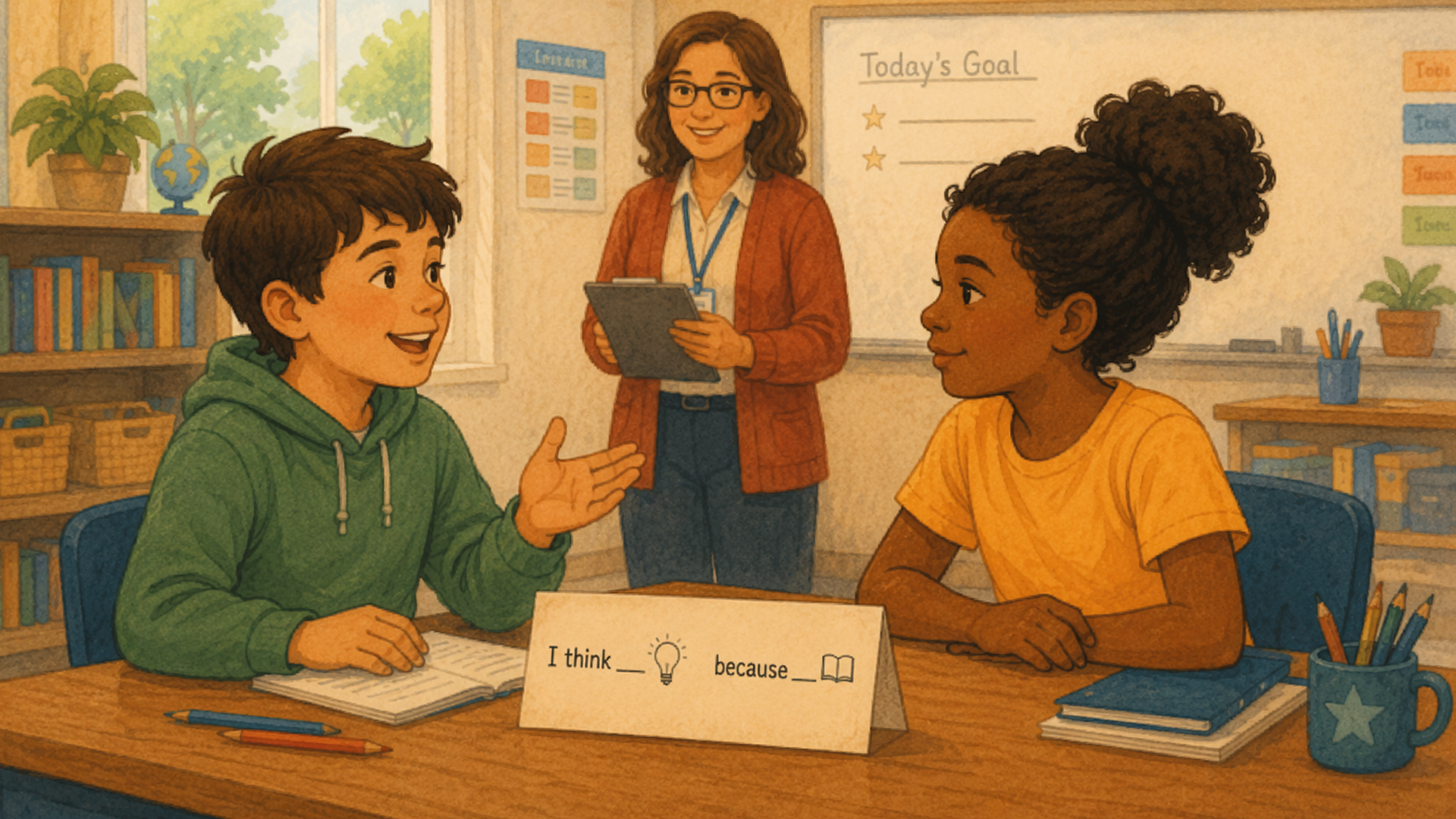
Structured discussion is one of the most powerful tools for language development in adolescence, as teens need authentic communication opportunities connected to belonging and participation.
Strong secondary classrooms intentionally build opportunities for:
- partner discussion
- reciprocal teaching
- fishbowl conversations
- collaborative reasoning
- claim-evidence-reasoning routines
- and structured peer interaction
Discussion provides oral rehearsal before writing and helps students practice disciplinary language in meaningful contexts.
That’s exactly why students who regularly engage in structured academic discussion often become more willing to participate in whole-class conversations, defend their reasoning, and contribute to collaborative learning.
Strategy #4: Support Identity, Belonging, and Multilingualism
If you have worked in education with multilingual learners, you know that language, identity, belonging, and long-term motivation are all strongly connected.
There are practical, concrete strategies for this, including:
- multilingual identity projects
- culturally responsive curriculum
- home-language supports
- bilingual discussion opportunities
- multilingual texts and resources
- and connecting learning to students’ lived experiences
One example is students creating bilingual or multilingual “identity texts” tied to course themes or community issues.
These activities strengthen both academic language and belonging at the same time.
For adolescents, belonging can strongly influence whether students participate consistently, persist through challenges, and see themselves as academically capable.
Strategy #5: Use Ongoing Formative Assessment
Formative assessment helps teachers monitor language growth in real time rather than waiting for annual data.
Some effective practices are oral rehearsal before writing, exit slips, annotated exemplars, peer feedback, conferencing cycles, and student self-assessment routines.
Language assessment should go beyond evaluating correctness. Teachers also need visibility into how students are using language to communicate ideas, explain reasoning, and participate in academic tasks.
What Coherent Secondary Support Systems Look Like
Effective secondary systems integrate language development with grade-level access. At the same time, they monitor students, build family partnerships, incentivize interdisciplinary collaboration and multilingual pathways, and expand access to advanced coursework.
Some of the specific ways we’ve seen and helped schools do this are through:
- current and former EL monitoring systems
- collaborative teacher planning routines
- multilingual family communication structures
- Seal of Biliteracy pathways
- interdisciplinary data review teams
- and shared responsibility across departments
A specific implementation timeline for your school or district will vary depending on particular factors, demographics, and needs. However, it should always include these steps:
- Auditing EL, newcomer, and former EL data
- Identifying gaps in course access and graduation pathways
- Building cross-functional teams
- And launching multilingual communication systems early in the school year
Strong systems distribute responsibility for multilingual learner support across the school. They build language development into schedules, course access, monitoring routines, family communication, and instructional planning.
That schoolwide approach becomes especially important in secondary settings where students interact with multiple teachers, departments, counselors, and intervention systems every day.
Adolescence Is a Critical Period for Multilingual Support
Adolescence is the period when multilingual support often becomes more important.
By middle and high school, students are simultaneously navigating academic language development, identity formation, graduation pathways, peer belonging, and long-term future opportunities.
Strong schools recognize that language development in adolescence requires intentional systems, coordinated support, and meaningful access to rigorous learning opportunities.
Reclassification should be celebrated, but it should not signal the end of monitoring, pathway planning, or academic support.
When schools invest in coherent multilingual systems, they strengthen participation, academic achievement, graduation pathways, and long-term student opportunity across the entire school community.
If you would like to know more about how your school can create stronger systems and have better responses to your teenager’s needs, you can contact Ensemble Learning directly or read more at our Learning Center.