
Schools that are working to strengthen educational leadership and management launch new initiatives all the time.
Districts may prioritize literacy improvement, invest in attendance campaigns, or introduce new instructional or school climate frameworks.
The challenge is that, over time, many improvement efforts begin to feel disconnected from one another.
Teachers hear one priority during professional development, another during walkthroughs, and something different during evaluation conversations. Student support teams meet separately from instructional teams. Family communication focuses heavily on logistics, while academic priorities remain largely disconnected from home partnerships.
This happens because their own systems are pulling in different directions.
On the one hand, educational leadership helps schools define what matters most for students and the staff and why.
On the other hand, educational management creates the structures, schedules, staffing patterns, coaching systems, meeting routines, and accountability processes that allow those priorities to become part of everyday school life.
Strong schools integrate both educational leadership and management in ways that keep instructional priorities connected to daily practice.
In this guide, we explore key areas where leadership and management collide, as well as how leaders can integrate tools and goals from both to create a better learning environment for everyone involved.
Contents
- 1 What Is Educational Leadership and Management?
- 2 What Exactly Happens When Educational Leadership and Management Are Disconnected
- 3 6 Key Areas Schools Should Integrate for Better Leadership and Management
- 3.1 Key Area #1: Instructional Coherence and Curriculum Alignment
- 3.2 Key Area #2: Collaborative Data Inquiry and Continuous Improvement
- 3.3 Key Area #3: Staff Development and Distributed Leadership
- 3.4 Key Area #4: Integrated Student Support Systems
- 3.5 Key Area #5: Family and Community Partnership
- 3.6 Key Area #6: Time, Budget, and Operations Alignment
- 4 Common Mistakes Schools Make During Improvement Efforts
- 5 How Schools Can Start Integrating Leadership and Management Systems
- 6 Educational Leadership and Management Are, at Their Core, a Design Challenge
What Is Educational Leadership and Management?
Educational leadership and educational management are often discussed as separate concepts (because they are), but in practice they operate together.
- Leadership establishes vision, instructional priorities, school culture, shared expectations, and urgency around improvement.
- Management operationalizes those priorities through schedules, staffing, budgets, team structures, data systems, coaching cycles, and follow-through processes.
Schools tend to struggle when there is a disconnect between vision and implementation.
For example: A leadership team may communicate strong instructional goals, but if collaboration time is inconsistent, meetings lack focus, or coaching cycles are disconnected from classroom priorities, the motivation won’t last.
Issues can happen the other way around: schools can also become highly operational without a clear educational purpose. Teams meet regularly, calendars stay full, and systems continue running, but staff members are left wondering how those activities connect to student learning.
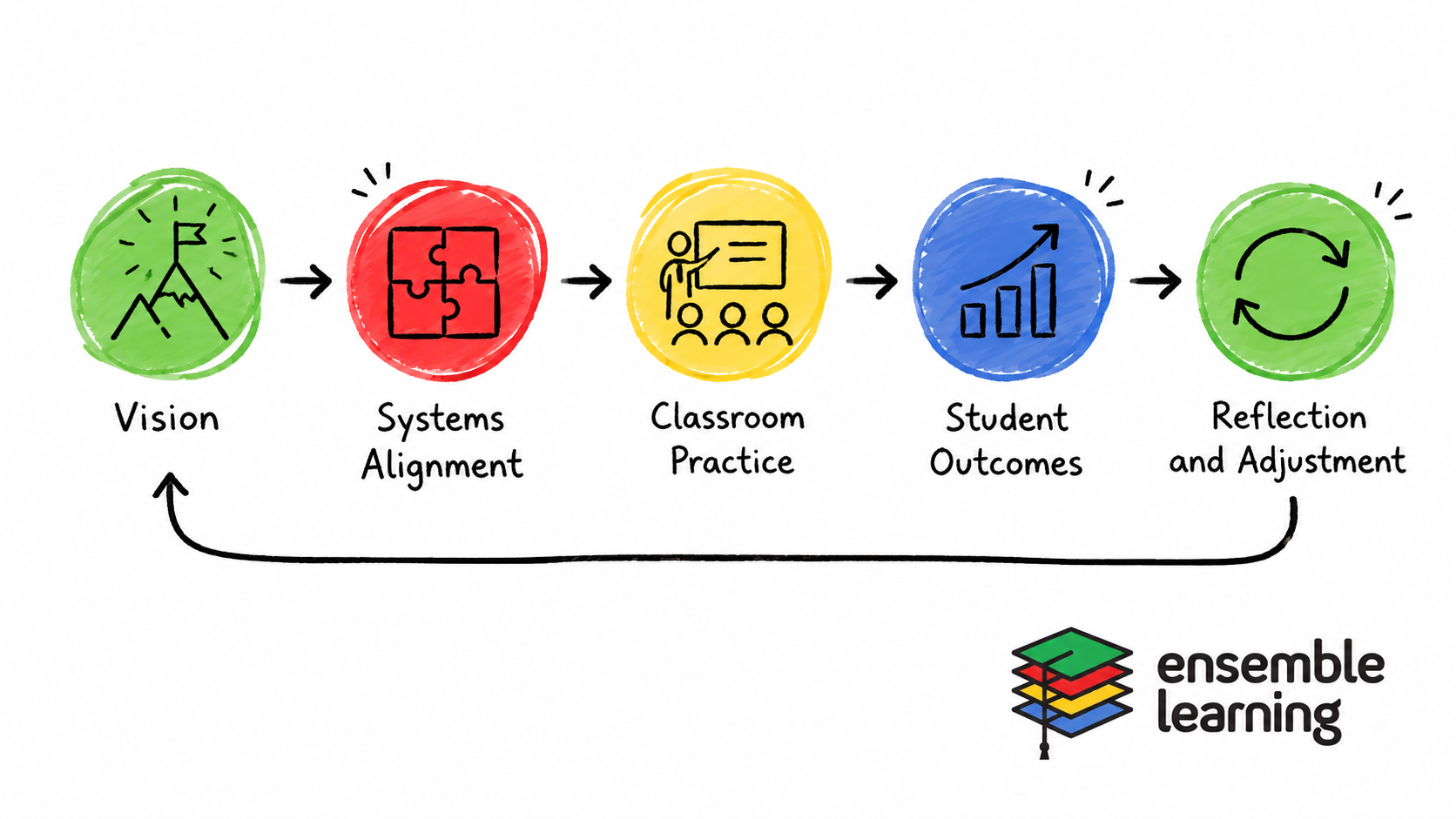
A practical way to think about integration is: When schools organize systems around shared goals consistently, improvement becomes visible in classrooms, meetings, family communication, and student experiences.
What Exactly Happens When Educational Leadership and Management Are Disconnected
Schools we’ve worked with often show common signs of fragmentation like:
- initiative fatigue
- competing priorities across teams
- meetings that produce discussion but little implementation
- inconsistent follow-through
- disconnected student support systems
- uneven communication across departments
In our experience, improvement is greater when schools choose a few shared goals and organize their work around them, rather than pursuing several disconnected initiatives.
A familiar example looks like this:
Teachers attend professional development focused on academic discourse strategies. During walkthroughs, however, feedback centers primarily on classroom management. Professional Learning Community (PLC) meetings focus mostly on pacing calendars, and evaluation conversations emphasize unrelated instructional goals.
Each initiative may have value on its own, but together they create confusion.
Strong school improvement efforts simplify and align expectations across different supports like coaching, observation, curriculum, professional learning, student supports, family communication, and operational systems.
6 Key Areas Schools Should Integrate for Better Leadership and Management
Key Area #1: Instructional Coherence and Curriculum Alignment
Instructional coherence is one of the clearest examples of educational leadership and management working together.
- Leadership defines what strong teaching and learning should look like.
- Management ensures schedules, planning structures, coaching cycles, observation systems, and professional learning reinforce those expectations consistently.
Strong schools often focus on a small number of observable instructional priorities instead of introducing too many competing strategies at once.
For example, a school may identify academic discourse, evidence-based writing, or reading comprehension as a central instructional focus for an entire term.
Announcing a priority alone is rarely enough for implementation. The priority has to appear consistently in:
- collaborative planning meetings
- walkthrough feedback
- coaching conversations
- curriculum-aligned assessments
- teacher collaboration routines
For this to work, schools need schedules that support teacher collaboration and protect time for stronger instructional alignment.
A practical starting point for schools is to choose one instructional challenge, identify two or three observable classroom “look-fors,” and embed those look-fors into coaching and walkthroughs for one semester.
For example, if a school is focused on literacy improvement, leaders might look for either students citing evidence during discussions, teachers modeling reading comprehension strategies, and/or collaborative analysis of student reading responses.
The goal is to reduce variability between classrooms so students experience more consistent instruction across the school.
Key Area #2: Collaborative Data Inquiry and Continuous Improvement
Schools often collect large amounts of data but struggle to turn that information into meaningful instructional decisions.
- Leadership defines which data matter most and sets the goals schools and districts want to achieve.
- Management is responsible for collecting the data and setting processes to interpret it and use it to move forward.
Collaborative data inquiry creates structured routines for moving from evidence to action.
Strong inquiry systems combine multiple forms of evidence, including but not limited to academic performance, attendance, climate and belonging, student work samples, family feedback, perception data, and more.
Students, staff, and teachers do not experience school in isolated categories, which is why integrated data review matters so much for improvement planning.
A student struggling academically may also be dealing with attendance issues, low belonging, inconsistent support systems, or communication gaps between school and home.
Collaborative inquiry routines help leadership teams identify root causes instead of reacting only to symptoms.
One practical recommendation is to create a simple dashboard with no more than six indicators tied to a specific improvement goal. Teams can review the dashboard every two to six weeks, identify trends, assign ownership, and determine next steps.
School teams can strengthen these routines by:
- bringing student work samples into PLC meetings
- documenting one instructional adjustment before the next meeting
- adding short student or family pulse checks when academic data alone does not explain the issue
Key Area #3: Staff Development and Distributed Leadership
Strong schools do not depend entirely on one principal.
- Leadership builds professional capacity, trust, and collective responsibility
- Management shapes the talent architecture: who leads teams, how leaders are prepared, how APs and teacher leaders are developed, how coaching works, and whether PD aligns with the school’s goals
A 2019 RAND report on principal pipelines concluded that leadership pipelines, coaching systems, and distributed leadership structures are associated with stronger achievement outcomes and higher leadership retention.
It found that schools with newly placed principals in pipeline districts outperformed comparison schools in reading and math after three or more years, while principal retention also improved. The estimated annual cost was approximately $42 per pupil, or less than 0.5% of district budgets.
Distributed leadership means schools intentionally build leadership capacity across teams.
That may include teacher-leader roles, instructional coaching systems, collaborative leadership teams, curriculum leadership positions, and principal mentoring structures.
Professional learning becomes more effective when it is directly connected to the school’s instructional priorities rather than delivered as disconnected workshops.
Effective PD is job-embedded, collaborative, tied to real instructional work, and connected to coaching and reflection cycles.
Instead of one-time presentations, schools can create ongoing cycles where educators:
- learn a strategy
- apply it in classrooms
- analyze evidence
- receive feedback
- revise and refine implementation
A practical starting point is mapping current school priorities against existing leadership roles.
Leadership teams can ask:
- Which responsibilities are concentrated too heavily on one administrator?
- Where are teachers already informally leading?
- Which instructional priorities currently lack ownership?
School-level strategies may include creating teacher-leader roles with protected collaboration time, aligning appraisal systems with one or two instructional priorities, and using PLC time for rehearsal and feedback tied to current student work.
Key Area #4: Integrated Student Support Systems
Attendance, behavior, climate, mental health, and academic support are often managed through separate systems.
Students, however, experience these challenges simultaneously.
- Leadership connects attendance, behavior, mental health, climate, and belonging to learning
- Management builds the tiered teams, referral rules, data routines, and supports that allow the school to respond coherently
Strong systems typically include principal-led student support teams, tiered intervention structures, shared referral systems, combined attendance and intervention meetings, regular climate and belonging reviews, and more.
Instead of running separate meetings for attendance, discipline, and interventions, schools can create one coordinated support structure with shared data, clear referral processes, and defined follow-through routines.
This helps reduce duplication and improves response time when students need support
A practical first step is reviewing chronic absence, discipline, and climate data together for one student group or grade level.
Leadership teams can then identify duplicate meetings, inconsistent intervention processes, communication gaps between departments, unclear referral pathways, and other areas that might be affecting performance.
Attendance Works Guide recommends creating principal-led attendance teams and cross-functional district teams that meet regularly, use timely data, and create shared accountability structures.
Key Area #5: Family and Community Partnership
Schools sustain improvement more effectively when families become active partners in learning and decision-making.
- Leadership frames families as partners in learning and belonging; and sets the tone to approach and create relationships with them.
- Management creates the communication routines, translation supports, outreach methods, and decision-making structures that make partnership real.
If your school is still approaching family engagement primarily through event reminders, generic newsletters, and one-way communications, most likely you’re not getting the desired results.
There should be a shift toward relationship-based partnership structures that help families participate meaningfully in school improvement and student learning.
That may include multilingual communication systems, translation and interpretation support, family advisory structures, community partnership networks, learning-linked communication, or shared improvement planning opportunities.
Schools can begin by auditing one month of family communication and asking:
- Are messages mostly logistical?
- Do communications help families support learning at home?
- Are families invited into decision-making processes?
- Is communication truly two-way, with families able to respond and influence decisions?
Natural trends in education highlight the value of personalized, learning-linked communication instead of reminder-heavy messaging. For example, schools may send updates connected to attendance trends, reading routines, student learning goals, or upcoming family-teacher conversations.
When schools treat families as co-educators rather than passive recipients of information, trust and engagement strengthen over time.
Key Area #6: Time, Budget, and Operations Alignment
This area is often overlooked, even though it may be one of the most influential parts of sustainable school improvement.
- Leadership defines what the school values, how those values align to the mission and vision, and what day-to-day adult actions should look like.
- Management proves it through calendars, meeting structures, staffing patterns, purchasing, transport, room use, intervention blocks, and budget decisions.
Even the best goals and concepts cannot function without proper structures to bring them forward. This can be done by, for example, auditing recurring meetings and calendars, protecting collaboration blocks, aligning spending with instructional priorities, reducing low-value operational routines, and/or reallocating resources toward shared goals.
A school may emphasize collaboration publicly, but if planning time is regularly interrupted, the operational system weakens the instructional vision.
Similarly, improvement initiatives struggle when budgets, staffing patterns, or meeting structures remain disconnected from school priorities.
One practical recommended starting point is conducting a calendar and meeting audit.
During it, leadership teams can ask:
- Which meetings directly support school priorities?
- Which recurring routines create the most instructional value?
- Where is staff time being consumed without improving outcomes?
- If only two priorities survived next semester, what would remain on the calendar?
Common Mistakes Schools Make During Improvement Efforts
- Trying to improve too many areas simultaneously: Schools often overload staff with competing initiatives instead of focusing deeply on a small number of shared priorities. A more sustainable approach is to identify two or three high-leverage priorities for a semester or school year and pause lower-value initiatives temporarily.
- Treating collaboration as compliance: PLC meetings can become procedural rather than instructional when teams focus mainly on logistics, pacing, or paperwork. Schools can strengthen collaboration by using fixed inquiry protocols with clear questions, evidence reviews, action steps, owners, and review dates.
- Using data without action cycles: Without structures for interpretation, testing, and adaptation, teams often spend large amounts of time reviewing data dashboards without changing instructional practice. Schools can begin by limiting meetings to a small number of indicators tied directly to one improvement problem and documenting one instructional adjustment before the next meeting.
- Fragmented student support systems: Separate meetings and disconnected intervention processes often create duplication, confusion, and inconsistent follow-through. Assigning named owners, creating shared data routines, and clarifying across teams how decisions are communicated can change the game.
- Family engagement that remains symbolic: Schools sometimes host events or send newsletters without creating meaningful structures for partnership tied to learning and decision-making. A practical first step is shifting from event-heavy outreach toward smaller, more consistent communication routines connected to student learning and family voice.
How Schools Can Start Integrating Leadership and Management Systems
Phase 1: Diagnose Needs and Set Priorities
During the first phase, schools identify gaps, redundancies, and opportunities for alignment.
Leadership teams can take the time to audit current systems and routines, identify overlapping initiatives, select two or three high-leverage priorities, establish baseline metrics, and identify current barriers to implementation.
We recommend keeping priorities narrow enough (ideally two or three) that teams can realistically sustain focus over time.
Ideally, this is done at the end of the school year, during the summer, and/or right at the beginning of the first semester.
Phase 2: Align Systems and Roles
Once priorities are identified, schools begin aligning schedules, meeting structures, leadership responsibilities, and coaching systems around those goals.
This is done through protecting collaboration time, clarifying leadership ownership, redesigning PLC routines, launching inquiry cycles, aligning communication systems, embedding coaching into instructional priorities, and other specialized processes.
Phase 3: Monitor and Adjust
Strong implementation systems include regular reflection and adaptation.
In order to do this, schools can review implementation evidence regularly, analyze academic and climate data together, gather student and family feedback, adapt supports based on findings, and scale successful practices gradually.
Schools often find more valuable insights when using both implementation indicators and outcome indicators rather than waiting only for annual achievement results.
Educational Leadership and Management Are, at Their Core, a Design Challenge
Educational leadership and management become transformative when schools align vision, instruction, systems, operations, and relationships around a shared purpose.
Long-term improvement depends on whether school priorities become visible in everyday experiences for teachers, students, and families. Staff members should be able to recognize those priorities in team meetings, coaching conversations, planning structures, family communication, intervention systems, and operational decisions.
When people, time, evidence, and resources all support the same instructional and organizational priorities, improvement becomes more manageable to implement and more visible in classroom experiences.
Educational leadership and management are ultimately reflected in how schools organize adults, systems, routines, and resources so stronger teaching, more responsive support systems, and coherent improvement practices become part of everyday school life.
If you would like to know more about how your school can create stronger systems and have better responses to your unique needs, you can contact Ensemble Learning directly or read more at our Learning Center.