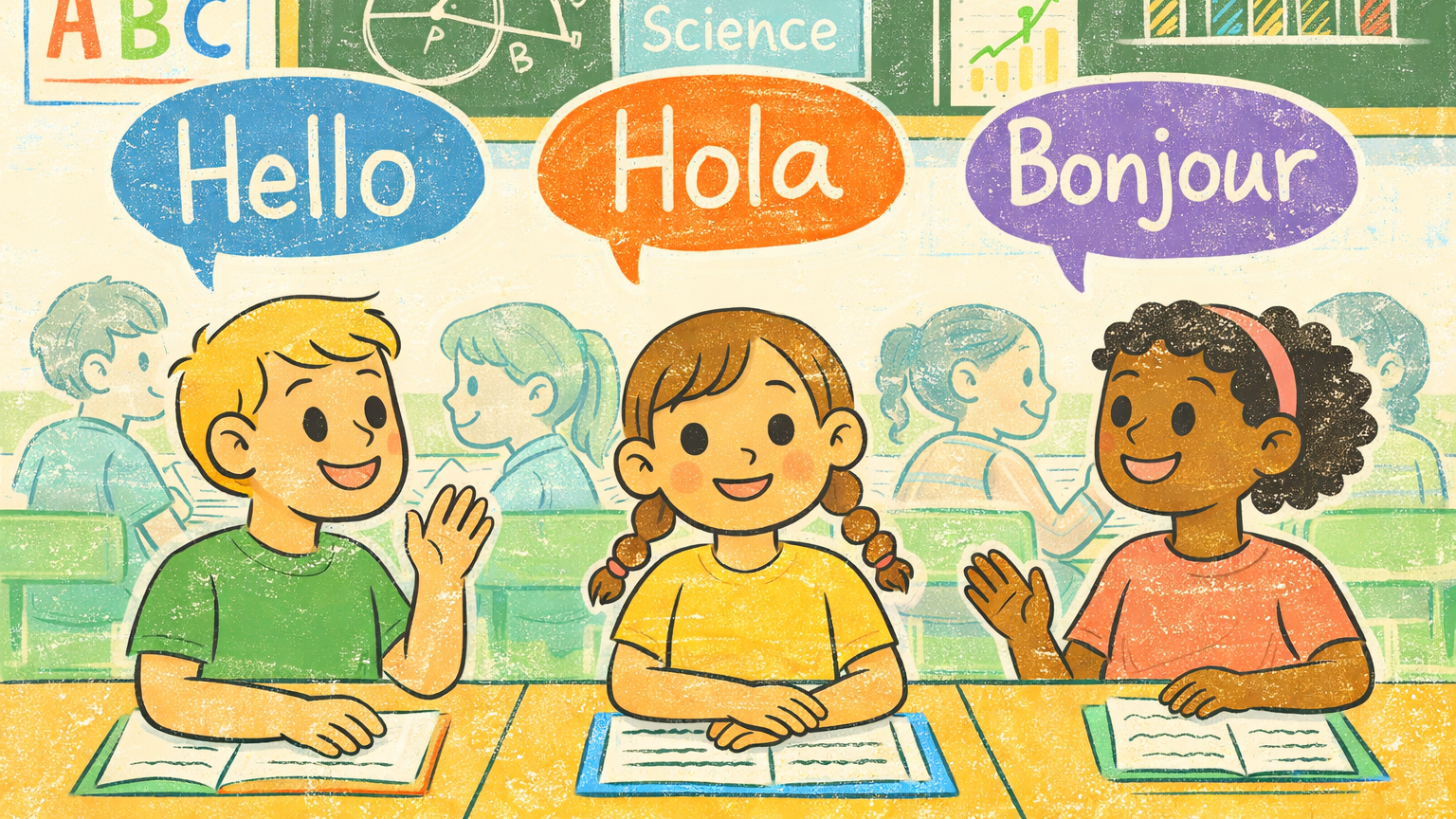
Emergent bilinguals are students who are developing English proficiency while maintaining and building upon their home language.
This dual language development is an asset that contributes to students’ academic achievement, cognitive flexibility, and long-term success.
Despite this, many schools still treat language development as a short-term need.
Think about your own system for a moment: when do supports really taper off for emergent bilinguals, and why?
In many schools, support is often concentrated in the first year, then reduced or removed once students are reclassified. On paper, that looks compliant. In classrooms, it often feels like a cliff.
This guide proposes a different approach: designing a continuum of support that follows students throughout their educational journey, even after meeting the standard English requirements.
At Ensemble Learning, we’ve experienced first-hand that when schools view multilingual learners through an asset-based lens and align systems to their evolving needs, they create more equitable and sustainable learning environments.
Contents
But First, Who Are Emergent Bilinguals?
The term “emergent bilinguals” acknowledges the linguistic strengths and potential of multilingual learners.
It includes:
- Newcomers: Commonly refers to recently arrived students, new to both U.S. school system and the English language
- Long-term English learners (LTELs): Students in U.S. schools for multiple years without yet reaching full proficiency
- Reclassified students: Learners who have met exit criteria but still need support with academic language and other areas
As you read about these groups, who comes to mind in your own school? Whose name shows up in data meetings again and again, and who has quietly disappeared from the conversation since reclassification?
These groups represent a wide range of experiences, from students with strong literacy in their home language to those with interrupted formal education.
An effective support system recognizes these differences and designs around them. If you looked at your current interventions list, would a newcomer with interrupted schooling and reclassified tenth grader land in the same place, or somewhere different?
What Newcomers Need Most (First 6–12 Months)
The first year in a U.S. school is foundational and the focus of most emergent bilingual programs.
When schools prioritize safety, clarity, and belonging, newcomers are more likely to step into their environment and feel confident in it.
Key areas of support include:
- Emotional Safety and Belonging: Trauma-informed environments, bilingual staff, and peer mentors help ease transition and reduce isolation.
- Clear Routines and Visual Supports: Visual schedules, translated signage, and consistent classroom structures promote understanding and reduce anxiety.
- Accessible Language Input: Use of gestures, visuals, realia, and translated key vocabulary enables students to begin understanding and using English in meaningful ways.
- Cultural Affirmation and Family Engagement: Instruction should reflect students’ backgrounds. Family communication in home languages strengthens trust and helps students feel seen.
Here’s a helpful guiding question for your team: If a newcomer walked into your school tomorrow, which of these supports would they experience in the first week, and which would still be “in development”?
What Emergent Bilinguals Need Beyond the First Year
Once students move past the newcomer phase, they still require targeted support,.
For many schools, this is where support quietly faces while the language demands of texts and tasks climb.
Helping them often means:
- Ongoing Academic Language Instruction: Teachers must explicitly teach the vocabulary, sentence structures, and discourse patterns specific to content areas.
- One way to reflect is to grab a recent unit plan and ask: Where, specifically, did we name and teach the academic language students would need, and where did we assume they would “pick it up”?
- Participation and Discourse Routines: Strategies like sentence frames, structured discussions, and group protocols give students opportunities to build oral and written language at the same time they’re learning course work.
- A helpful question to ask is: Who is doing most of the talking during lessons, and which routines are intentionally designed to ensure multilingual learners have structured, low-risk opportunities to speak, listen, and respond?
- Differentiation Without Simplification: Scaffolds and warm-demanding strategies should provide access to rigorous content, not water it down. Make sure to implement programs so your educational staff knows how to implement so-teaching models, integrated ELD, and formative assessments.
- Invest in coaching and professional learning so teachers feel confident using co-teaching models, integrated ELD, and ongoing formative assessment, rather than relying on simpler texts as the main support.
- Monitoring Growth: Language goals should be embedded into classroom assessments and progress monitoring cycles, especially for students recently reclassified.
- To reflect, consider asking: How are we tracking language development over time, and do our assessments clearly distinguish between content understanding and English proficiency?
What Schools Get Wrong When Support Is Fragmented
Systemic gaps often appear when support for emergent bilinguals is limited to newcomers or ESL departments.
In our experience, we’ve seen schools make some of these 3 common mistakes:
1. Focus on one year programs for newcomers: While they begin with strong onboarding, it often fades quickly and leaves students unsupported exactly when they are developing more academic language.
a. If you look at your own newcomer program, is there a clear plan for years two and three, or are supports limited by financial resources and staff shortage?
2. Lack of collaboration between schools or areas: When ESL and general education teachers work in parallel instead of together, students receive mixed messages and unreliable support.
b. Consider your last PLC agenda. How often do language specialists and content teachers sit at the same table to plan for the same students?
3. Misinterpretation of reclassification: Reclassified students are often assumed to be fully proficient after a couple of years into the U.S. school system. However, academic language continues to develop for years.
c. After students reclassify, do you still talk about their language goals in meetings, or do those goals disappear from your data and radars?
A fragmented approach delays progress and can lead to student and family disengagement, lower achievement, and higher dropout rates.
What a Coherent System of Support Looks Like
A strong continuum must be embedded in schoolwide systems and driven by collaboration.
It should have:
Tiered Instructional Models: Incorporating language into MTSS or RTI frameworks ensures universal design principles at Tier 1 and targeted supports at Tiers 2 and 3.
Inclusive Teaching Practices: All educators are responsible for language development. Use visuals, sentence frames, accessible texts, and multilingual supports in science, social studies, art, and other content areas.
Professional Learning: Invest in sustained PD on sheltered instruction, translanguaging, culturally responsive practices, and formative assessment for language growth. When teachers are fully engaged, it doesn’t matter what grade or level of proficiency they’re teaching, because they will always integrate language teaching in their classrooms.
Shared Data Systems: Monitor both language and content growth through PLCs, data cycles, and reclassification tracking. As a school leader, classroom walkthroughs or shadowing can be great strategies for receiving comprehensive input and feedback.
Policy and Access: Ensure multilingual learners are represented in advanced courses, extracurriculars, and leadership roles. Provide culturally sustaining curriculum and resources.
Continuity Drives Belonging
Multilingual learners do not need temporary fixes, but continuity.
Their growth accelerates when supports evolve alongside them and reflect the realities of academic learning in a second language.
A true continuum of support:
- Builds from a strong foundation in the first year
- Scales with academic expectations
- Integrates language development across the curriculum
- Recognizes student identity as central to learning
By focusing on these principles, schools move from short-term intervention to lasting impact.
A concrete next step might be to map the journey of one emergent bilingual student across grades at your school and ask, “What support did they receive each year, and where were the gaps?”
If you are ready to move from isolated programs to a true continuum of support, we would be glad to think it through with you.
Reach out to explore how we can support your PD planning, leadership sessions, or broader school improvement work focused on emergent bilinguals.
Need help implementing a continuum of support at your school or district? Reach out to explore how we can support your PD planning, leadership sessions, or school improvement work.