Linguistic plurality in American classrooms is the norm.
And beyond presence, English Language Learners contribute dynamic perspectives, cultural depth, and multilingual insight to school communities.
However, supporting them takes creativity, strategy, and structure.
When teachers rely solely on pre-packaged curricula or one-size-fits-all instruction, they risk missing the full potential of their students.
This guide offers practical ELL teaching strategies for educators who want to build classrooms where multilingual learners are confident enough to make mistakes, and capable enough to go past them.
Disclaimer: In this guide, we use ‘English Language Learners (ELLs)’ and ‘multilingual learners (MLLs)’ to refer to students developing English while using one or more home languages. Keep in mind that, in other contexts, these terms may not be interchangeable.
We highlight 10 foundational strategies and offer step-by-step implementation guidance so your classroom and your school can be the safe space more than 5 million students nationwide need.
Contents
- 1 What Makes ELL Teaching Strategies Unique
- 2 Top 10 Instructional Strategies for ELL Students
- 2.1 #1 Visual Supports and Anchor Charts
- 2.2 #2 Sentence Frames and Word Banks
- 2.3 #3 Interactive Read-Alouds
- 2.4 #4 Think-Pair-Share with Language Scaffolds
- 2.5 #5 Total Physical Response (TPR)
- 2.6 #6 Use of Native Language (Translanguaging)
- 2.7 #7 Small Group Instruction
- 2.8 #8 Graphic Organizers
- 2.9 #9 Tiered Assignments (or Differentiated Instruction)
- 2.10 #10 Formative Assessments with Language Goals
- 3 How to Implement ELL Student Strategies Step by Step
- 4 ELL Teaching Strategies Across Grade Levels
- 5 Supporting ELLs in Multilingual Classrooms
- 6 Every ELL Teaching Strategy Counts, What’s Yours?
What Makes ELL Teaching Strategies Unique
Teaching English learners involves more than simplifying content or translating instructions. In fact, these activities alone do not help a lot.
As an educator, a helpful question to ask yourself is: When my ELLs struggle, is my first instinct to simplify the task, or to add the right supports so they can do the same thinking in a more accessible way?
If teachers want to make a change and create authentic connections, then it requires intentional instructional shifts and specialized strategies that recognize the specific needs of multilingual students, all without lowering expectations.
Beyond their particular logistics, here’s what effective ELL teaching strategies have in common:
- Cultural and linguistic responsiveness: Valuing students’ home languages and lived experiences while making room for English learning.
- Academic language development: Supporting the use of discipline-specific vocabulary and syntax.
- Language and content integration: Teaching subject matter and language skills together in a coherent and supported way.
By integrating these characteristics, schools and educators can leverage the assets ELLs bring to the classroom—such as multilingualism, adaptability, and global perspectives—to support meaningful learning and holistic development.
Top 10 Instructional Strategies for ELL Students
Using high-impact, research and experience-based techniques for your ELLs doesn’t have to mean hours of prep.
At Ensemble, we’ve gathered 10 ideas to get you started:
#1 Visual Supports and Anchor Charts
Use co-created visuals, diagrams, word walls, and labeled materials throughout the classroom to reinforce academic vocabulary and key concepts.
You can leave them up as long as you want and they’ll act as reminders or active support in day-to-day interactions.
Materials or Resources Needed: Chart paper, markers, printed visuals, bilingual labels, sentence strips…
Why It Works: Visuals make abstract concepts more concrete. They support memory retention and offer consistent reference points for vocabulary and processes.
Try this: Choose one upcoming unit and plan at least one anchor chart or visual that will stay up for the entire unit as a shared reference.
#2 Sentence Frames and Word Banks
Offer structured support for speaking and writing activities. These tools help ELLs develop confidence and fluency while constructing responses using academic language.
Materials or Resources Needed: Sentence stem templates, vocabulary lists, laminated word banks, dry-erase boards. These can be printed in regular sheets or part of the visual supports in strategy #1.
Why It Works: These tools provide language scaffolds, reducing the cognitive load and helping students practice academic sentence structure with confidence.
Try this: During your next discussion or writing task, provide two or three sentence frames and observe if and how they change the quality of student responses.
#3 Interactive Read-Alouds
Model fluent reading, introduce challenging vocabulary, and offer opportunities for discussion. Use think-alouds and targeted questioning to deepen comprehension, and make sure students intervene according to their confidence and level.
Materials or Resources Needed: High-interest texts, sticky notes, anchor charts, sentence starters, etc.
Why It Works: Read-alouds model fluent reading, build background knowledge, and offer rich opportunities for vocabulary development and comprehension strategies. It also creates a safe space for mistakes.
Try this: Pause at one key moment during a read-aloud and invite students to predict, summarize, or explain using a simple sentence starter, for example.
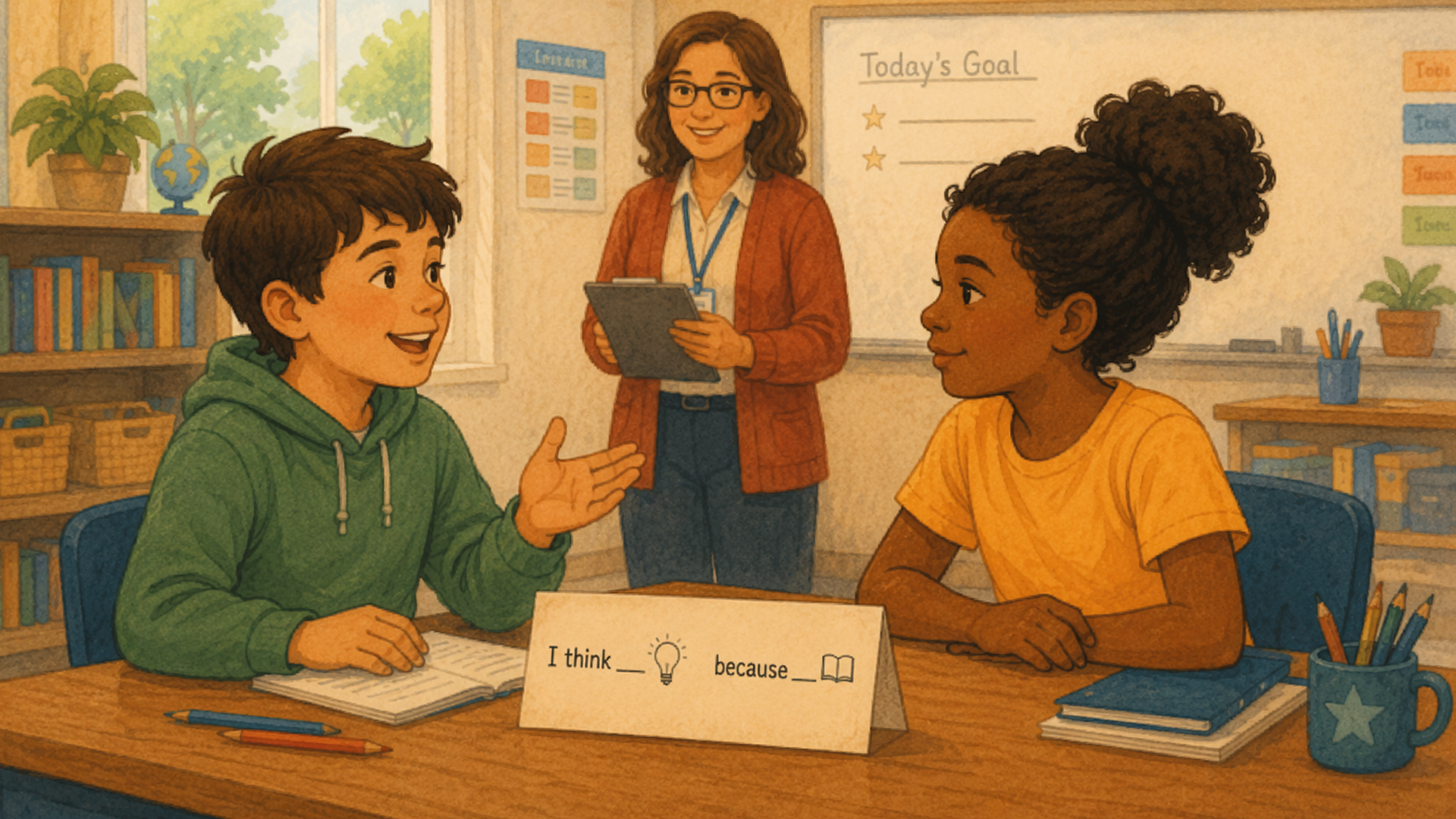
#4 Think-Pair-Share with Language Scaffolds
Provide sentence starters or visuals to support structured peer conversations. This technique encourages oral language development in a low-stakes setting.
Materials or Resources Needed: Discussion prompts, visual cues, sentence stems, partner roles, and ambience-setting.
Why It Works: This routine increases speaking opportunities and lowers anxiety by providing structure and peer support during academic talk.
Try this: Plan one discussion question and pair it with a sentence starter so every student has a clear way to begin conversation with their partner.
#5 Total Physical Response (TPR)
You can link movement with language by using gestures to teach vocabulary and classroom directions.
This one is especially effective for early-stage English learners, but it can also work for older students if they are more involved in the process of picking out the resources.
Materials or Resources Needed: Word cards, gesture prompts, movement space, songs, and/or video.
Why It Works: Movement reinforces meaning, particularly for beginners, and taps into kinesthetic learning pathways for stronger vocabulary acquisition.
Try this: Introduce two or three new vocabulary words this week using gestures or movement, and repeat them consistently during the lesson and on the following days if possible.
#6 Use of Native Language (Translanguaging)
Allow students to brainstorm, write, or reflect in their home languages before diving into their English answers. This affirms identity, supports cognition, and fosters content understanding.
Materials or Resources Needed: Bilingual dictionaries, multilingual texts, sentence frames in both languages, and extra sheets of paper.
Why It Works: Translanguaging honors students’ full linguistic resources and enables deeper content processing and stronger cognitive connections. It allows students to test if they really understand the topics and tasks beyond language barriers.
Try this: Before asking for an English response during one of your lessons next week, give students one minute or so to discuss or jot down ideas in their home language.
#7 Small Group Instruction
Use flexible grouping to provide targeted support based on language proficiency and content needs. This allows for personalized scaffolding and increased student talk time.
Materials or Resources Needed: Leveled texts, manipulatives, visual aids, group roles or task cards, flexible classroom layout.
Why It Works: Small groups allow for targeted instruction and more student talk time, which is critical for language development and confidence.
Try this: Use one recent formative check, such as an exit ticket, to create flexible groups for the next lesson. Make sure to vary the groups and avoid labeling them.
#8 Graphic Organizers
Use visual tools such as Venn diagrams, story maps, and timelines to support information processing and organization across all subjects.
Materials or Resources Needed: Pre-made templates (e.g., T-charts, timelines, diagrams), digital graphic organizer tools, colored pencils, markers or sticky notes.
Why It Works: Graphic organizers help students structure their thoughts, connect ideas, and visualize relationships in content areas. They also allow connections that aren’t necessarily tied to vocabulary or language understanding.
Try this: Select one complex task from an upcoming lesson and introduce a simple organizer that helps students break their thinking into steps or organize the data in a different way than they’re used to.
#9 Tiered Assignments (or Differentiated Instruction)
Provide tasks at varying levels of complexity aligned to student readiness, ensuring all learners access rigorous content meaningfully. This encourages students to better themselves with confidence and identify areas for improvement.
Materials or Resources Needed: Assignment menus, rubrics at multiple levels, extension options, scaffolding tools.
Why It Works: Differentiated tasks allow students to access rigorous content in ways that match their language proficiency and cognitive readiness, as well as make room for improvement and attend to every student’s needs.
Try this: Take one assignment and design two entry points: one with additional scaffolds and one with an extension challenge. Either quietly assign the entry points according to each student’s level, or let them pick for themselves.
#10 Formative Assessments with Language Goals
Incorporate quick checks for understanding that measure both content mastery and language development. Use rubrics that target language domains.
Materials or Resources Needed: Exit tickets, observational checklists, student self-assessments, domain-specific rubrics.
Why It Works: Assessing language development alongside content understanding helps teachers provide timely, targeted support and track growth over time.
Try this: Add one language-focused question or rubric criterion to your next exit ticket to capture how students are using academic language.
How to Implement ELL Student Strategies Step by Step
From Planning to Practice in Multilingual Classrooms
Effective implementation requires more than selecting the right technique. Educators should use a structured process to ensure consistent support for English learners.
Also, when you plan, consider choosing one or two strategies to focus on per unit, rather than trying to do all previous ten at once.
- Prepare the Environment
Create a welcoming, print-rich classroom with multilingual signage and culturally relevant visuals. Normalize the presence of multiple languages. - Set Language and Content Objectives
Plan lessons with both academic standards and language goals in mind. Share objectives with students and refer back to them during instruction.
For example, a content objective might be ‘Describe the water cycle,’ and a language objective could be ‘Use sequence words like first, next, and finally to explain the water cycle orally.
- Choose the Right Tools
Incorporate supports like bilingual dictionaries or books, digital tools (e.g., Google Translate, TalkingPoints, Seesaw, and more), realia, sentence stems, and visuals. - Establish Routines for Practice
Use consistent routines that give students daily practice with speaking, writing, listening, and reading in meaningful and useful ways. - Monitor and Adjust
Use formative data to assess progress and adapt instruction. Collaborate with co-teachers, interventionists, and ELL specialists to refine strategies.
ELL Teaching Strategies Across Grade Levels
Tailoring Instruction for Elementary and Secondary Students
Effective instruction varies depending on student age, academic level, and language proficiency.
Therefore, strategies will look different depending on your group.
In elementary classrooms, use strategies such as:
- Visual storytelling and picture books
- Songs, chants, and rhythm-based routines
- Repetitive sentence stems and modeled conversations
In secondary settings, focus on:
- Explicit instruction in academic vocabulary and discourse
- Scaffolded supports for reading complex, content-area texts
- Structured peer collaboration and classroom discussion norms
For newcomer or early-stage ELLs, integrate:
- Visual schedules and bilingual instructions
- Buddy systems and multilingual peer support
- Home language use as a bridge to new learning
And as a final, general question that goes beyond grade bands, you might ask: ‘How often are my multilingual learners talking about ideas, not just filling in blanks?
Supporting ELLs in Multilingual Classrooms
Most ELLs learn in multilingual classrooms where students speak a range of home languages. This diversity offers opportunities to foster connection, confidence, and global awareness.
Educators can build fairer classrooms by:
- Encouraging translanguaging: Let students use all their language resources
- Promoting peer collaboration: Observe dynamics to use strategic pairing and group roles
- Celebrating language and culture: Center students’ identities through text, projects, and classroom events
- Collaborating schoolwide: Align supports across content areas and grade levels instead of only focusing in ESL programs. This means general education teachers, not just ESL specialists, see themselves as responsible for language development.
Every ELL Teaching Strategy Counts, What’s Yours?
Supporting English learners requires intentionality, flexibility, and a deep belief in students’ strengths. With ELL teaching strategies, there are plenty of options for combining the support you give as an educator and the challenges you ask from students.
This is why when teachers implement targeted, inclusive ELL teaching strategies, they open pathways to academic achievement, confidence, and a stronger sense of belonging.
Start by choosing two or three strategies that align with your classroom goals. You might even jot a quick note after each lesson about how your ELLs responded to a new strategy, so your practice evolves based on what you see and hear. Then, adapt and refine them. Reflect on what works. Try again.
With every adjustment, you’re building a more inclusive, equitable learning environment for all students.
If you would like to get inspired and explore additional resources for your MLLs, you can visit our Learning Center or get in contact with Ensemble Learning’s team.